Community & Business
28 August, 2025
Newspapers cease printing - not for lack of news!
OPINION PIECE: by Lucie Peart, managing editor of Gilgandra Newspapers and president of Country Press NSW Inc.
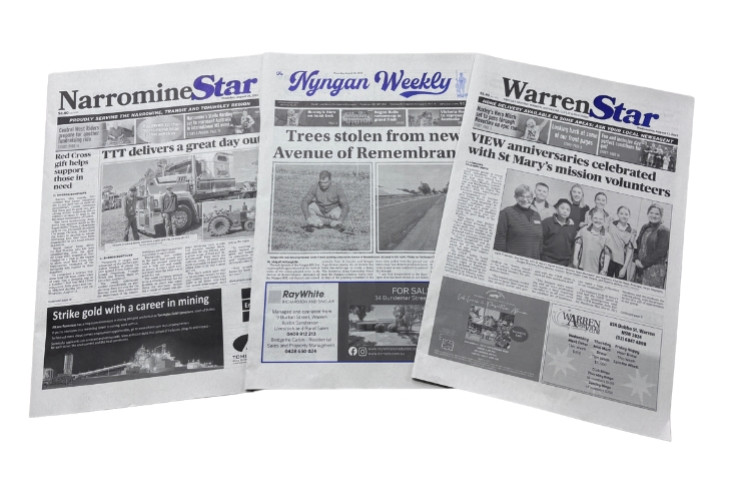
This week we published three final editions in print for local newspapers in Warren, Narromine and Nyngan.
I know what you might be thinking, not enough going on?
Let me clearly state – it is not for a lack of news!!!
Some weeks, with our small resources we can barely scratch the surface of what goes in a regional NSW town with a population around 3000-5000.
Sadly, these three communities have lost their publications before.
Nyngan and Narromine’s former long-serving newspapers were closed by Australian Community Media in 2020, and Warren lost its local independent paper in 2022.
This new closure means one community – Narromine - is now without a local newspaper for the second time in five years.
But two others – Warren and Nyngan – will combine into a new publication offering those communities a way forward to be a sustainable print newspaper.
During the pandemic many print edition newspapers were closed.
Gilgandra Newspapers, publisher of The Gilgandra Weekly, remained strong during COVID.
I, inspired by other colleagues in the Country Press Australia network, started to think that as a local mono printer we were nimble enough to return print editions to smaller communities. It was a gamble, one undertaken in excitement and passion for newspapers – particularly print.
The Nyngan Weekly was first in 2020 and not long after, Narromine Star and finally Warren Star followed in partnership with adjacent publishers of the Dubbo Photo News.
We were embraced by the community initially but have struggled to maintain the local advertising support needed. Narromine began with foundation partner businesses – which over time – moved away from the paper. This was the beginning of the end.
We have held onto these print editions longer than was financially sensible – we did that for our staff and for the communities we serve because we always believed that they were greatly valued and, somewhat too optimistically, that things would turn around…
We know that in regional areas, print editions are still held up as the premium news product.
Australian’s love news – Roy Morgan research shows that 97 per cent of people over the age of 14 consume written news in a print or digital format.
Local and independent news producers (there 240 in the Country Press Australia network) are among some of the media industry’s most trusted brands.
We aren’t closing print editions because we don’t have a readership, albeit declining over time; and not because we don’t get a lot of support and submissions from local community and sport groups. We have the content!
The problem is that we as modern people have been instructed by the multi-national companies of the internet that the value of inclusion is now determined by how free that is to ‘self-publish’.
Therefore, a post on social media is deemed more valuable for the poster themselves than the audience it's posted to.
Recent studies are concluding that social media use has shrunk attention spans. People scan news online. We spend nearly two hours a day on social media and when we look at news online around 17 per cent of pageviews last less than four seconds.
Just four seconds - about the same time you just read those three words in your mind…
So, how is that a good return on investment for an advertiser or someone looking to get the word around? It’s not; and it’s fleeting.
Doomscrolling – the popular bedtime habit responsible for emptying bank balances the world over – has become ritualistic. But do you remember more than three things with clarity that you flicked past last night, this morning, even two minutes ago? Very rarely.
Online habits change all the time with new waves of popular apps and ways to connect online.
An ad in a print edition newspaper sits around the house for weeks before it’s recycled.
It can be read and re-read many times.
It is read by a whole household, a multitude of ages, not just the person who bought it.
That’s a good return on an investment.
And crucially for the investor – it takes the same time for you to deal with a real person at the newspaper office to book an ad or email them your story as it does to post it on social media with only a few words and one photo to describe the story.
So, why not do that instead?
Because you were taught something different and now you can’t break that habit.
The internet has given us so many benefits even in the print and media industry. But the real benefits have gone to the big tech companies that data mine personalities for profit.
The rise of AI also ensures that our copyright protected news is being further distributed without compensation to the publishers – another challenge the industry is just beginning to tackle.
So, what’s next? How do we make news ‘sexy’ again for advertisers?
Interest rate cuts, small business incentives for advertising, some sort of charitable arrangement – all these things have been floated.
But it all comes down to correctly recognising the value of a local news ecosystem in this country, then protecting and supporting that at all costs.
We are the last bastion of intelligence in this country – we have seen how the absence of real journalism plays out overseas. And we are also seeing how difficult it is to determine the truth online.
I don’t want my children to grow up thinking that one person’s two second opinion online is the real news. I want them to grow up engaged with their community, educated about what is happening at a local government level, in their community, in their sports team. I want them to value the truth and value the profession of journalism.
But as you are only skimming this online, read this one line:
Local newspapers need you to read them and local businesses should be advertising in them!